Where the path should have been
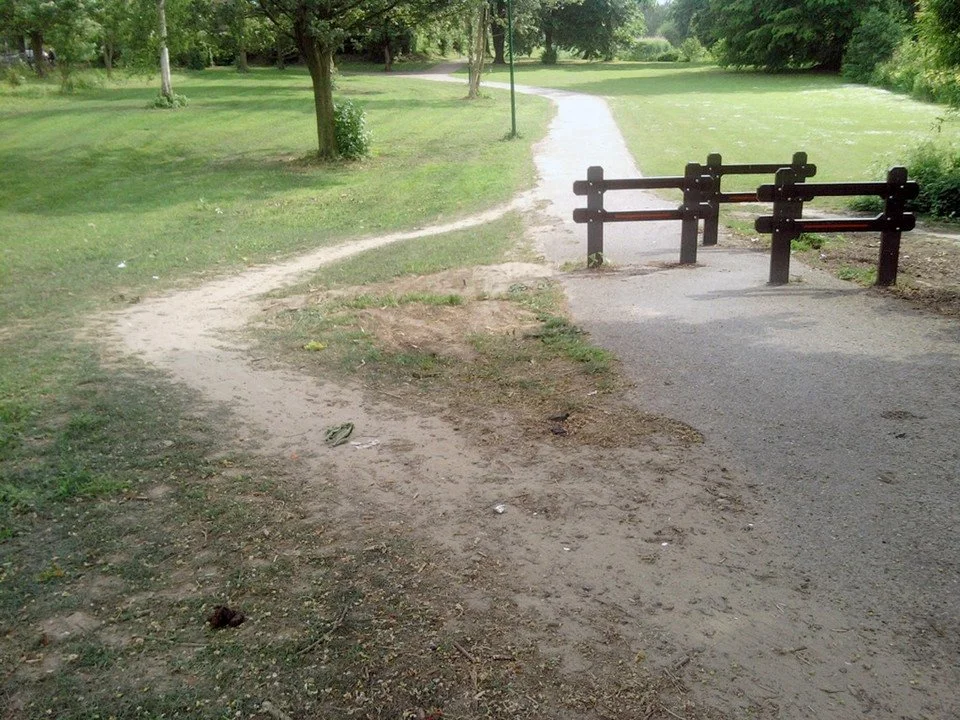
Desire paths tell a story about the gap between plan and practice
First published on Substack.
I walk the trails near my home. Some are wide fire trails designed for bushfire management. Others are well-worn paths eroded by previous visitors. Sometimes, cattle-created tracks have been taken over by humans. Still, there are lightly used tracks branching off the main paths. These tracks seem to serve little purpose for most people moving through the landscape, but for some, whether human or animal, they appear to be significant.
How walkers interact with their environment is a central theme in the study of social physics, and considerable attention is devoted to describing the emergence of spontaneously formed trail systems.
The language of paths
Landscape architects call these spontaneous tracks ‘desire paths’ or, less commonly, ‘desire lines’. The term originates with Gaston Bachelard's 1958 work ‘La Poétique de l'Espace’ and is rooted in the French ‘chemin de désir’, which, no doubt, conveys additional meaning lost in Google Translate.
It is a path driven not by convenience or a shortcut but by desire. It seems more poetic and romantic than other terms for the same feature: goat track, cow path, beaten track. I am drawn to the description of these tracks as ‘pirate paths’ because we are ‘breaking the rules’.
Nations rich in walkers have their own labels for these paths. The Germans call it ‘Trampelpfad’, meaning a trample path, which in one word captures what it is and how it forms. The Dutch refer to it as ‘olifantenpaadje’, meaning little elephant path, which is lovely and strange, evoking the image of an enormous, gentle creature refusing to detour.
Nobody is certain where all these names come from, which seems fitting for something that arises from anonymous, collective action.
The definition, at least, is simple enough: an informal trail formed by erosion, or by people or animals repeatedly taking the same route, leaving its mark on the landscape. They appear in the bush, across lawns, through empty lots, between apartment buildings, wherever the designed route and the intuitive one don't quite agree.
What makes them interesting is what they represent. In an urban setting, every desire path is a record of disagreement. Someone, whether an architect, a planner, a builder, or a committee, decided where the path should go. Then thousands of ordinary people, without coordinating, walked somewhere else.
Mr Bates experiment
In 1950, G.H. Bates of the Staffordshire County Council Education Committee published ‘Track Making by Man and Domestic Animals’ in the Journal of Animal Ecology. In it, he reports delightfully on his ‘singular opportunity’ to observe track formation in a previously unmarked field.
As one watched the man crossing the park, to and fro, twice daily, it was seen that he rarely looked up to take his bearings but generally trudged along, head down, with his eyes on the path. In using the path to guide him he was behaving in exactly the same way as cows and sheep…
For Bates, the narrowness of many long paths was puzzling because walkers often could not see the exact endpoint from where they entered a field, yet the paths varied little in width. Why, wondered Bates, do walkers not wander off the path once a path exists?
His observations of the unwitting gardener were a once-in-a-lifetime opportunity to answer these questions.
What Mr Bates discovered
Mr Bates concluded that a lasting path is created by repeated use once a visible or physical trace exists, such as footprints, bruised grass, or mud, after which the walker tends to follow that marked path and may even shift to a newly marked route if it becomes the clearer guide.
It seems like an unremarkable conclusion, but his observation on how to get there is interesting.
Bates observed that the gardener rarely looked up for bearings, even though he couldn’t see his destination, instead using the developing path itself as his guide, as cattle and sheep do. It might be called head-down guidance.
A heavy fall of snow, ‘which lay for several weeks’, obscured the original path and prompted new observations.
After his initial journey across the snow, the gardener followed the footprints he had left, creating a clearly defined trail. Bates observed that this trail seemed to align with the old path in the grass. However, once the snow melted, it became clear that the snow-formed footpath did not exactly match the original grass path. The old route, where it diverged, remained faintly visible, but the gardener chose to continue following the new path.
Bates concluded that trails are marked by bruised grass and wet conditions. Long grass, which can be bent or damaged, along with wetness that causes soil marks, creates a visible line that later becomes a path for subsequent crossings. Repeated use produces lasting changes that stay visible for one or two years, even after the path is no longer used. For Bates, people use head-down guidance to set and follow a general path, similar to cattle and sheep.
In 1997, physicist Dirk Helbing and his colleagues published ‘Active Walker Model for the Formation of Human and Animal Trail Systems’ in the journal Physical Review E, using advanced modelling equations to simulate how pedestrians and ants form trail systems. Essentially, the paper argues that there is a feedback loop between people and the landscape.
The modelling is more comprehensive than Bates could have imagined, but Mr Bates’s observations and conclusions remain valid.
Desire paths are everywhere
Once you start looking for desire paths, you find them everywhere, and not just on the ground.
A software designer creates an app with a planned sequence of screens, a flow, intending for users to move seamlessly from one step to the next. However, feedback reveals that half of users click the back button three times, bypass the main navigation, and bookmark pages they weren't intended to access directly. This is also a desire path: users navigate their own way, not following the path carefully laid out for them.
The difference from a physical desire path, though, is that digital ones are invisible. You need heatmaps, analytics, and keyboard recordings to see the digital paths people are taking, possibly using the same head-down guidance Bates observed.
Our careers are supposed to follow a trajectory of education, an entry-level position, steady progression, and retirement. But the shape of most people's working lives zig-zag, double back, cut through unexpected territory, and pause in places that don't appear on the official map. In a job interview, we feel the need to craft a story that gives coherence to these moves. We might be apologetic for not following the path laid out for us, but maybe the path is just the path and requires no further explanation or apology.
The pattern is always the same. A system is designed. People use it differently than expected. The evidence of that difference starts to accumulate until it becomes the reality, not the plan.
Desire paths are stories
A desire path is a story. It tells us about the gap between the designed experience and the lived one. It doesn't say who's right. Sometimes the design needs to change. Sometimes the design exists for a reason we haven’t considered. Our desire paths are not always the best option. Most of the time, the truth is somewhere in between.
We are always being told where to ‘walk’—by architects, algorithms, institutions, and societal expectations, and by the well-meaning plans others have made for us. Usually, we stick to the designated path. However, occasionally, without fuss or explanation, we lower our heads and walk across the grass. When enough of us do this, the ground remembers, and a new path is formed.
