Walking with Water: Two Summers with Bashō
The walker’s task is not to hold on. It is worth noticing and letting that noticing change us. The water will do the rest.
First published on Substack.
During summer, the Kosciuszko Main Track hike begins at Charlotte’s Pass and crosses the Snowy River. It’s not as grand as a river; instead, it’s a narrow, icy ribbon no wider than a step, flowing through soft grasses and alpine flowers. Crossing the stream quickly immerses me in nature.
Mountain biking has become a popular summer activity in the national park. It’s a fast-paced sport that rushes past the landscape’s finer details. Walking, on the other hand, moves more slowly, blending movement with careful observation.
What makes a water crossing stand out or transforms a trickle into a boundary is the harmony between the stream’s size and the person’s movement beside it. Stride and stream blend together, neither rushing ahead of the other. Walking becomes about more than just the feet; attention turns outward, moving alongside the water. This is the specific kind of attention that emerges when they come together.
I have come late to this experience, the seventeenth-century Japanese poet’s observations on crossing one threshold after another, which have persisted across time, geographies, and cultures.
Bashō and the discipline of noticing
The Japanese poet Bashō’s travel journals start at a crossing. Oku no Hosomichi — the narrow road leading into the interior — begins with the poet leaving his hut, boarding a boat, and travelling north through barriers and rivers into a land celebrated by earlier poets. Crossings and boundaries serve as transitions that heighten awareness.
Attention is focused through a discipline known as kigo, or the season word. Typically, each haiku contains one: a specific flower, a cicada, rain, frost, fruit, or a shift in light that signals a particular time of year. Without a kigo, a haiku seems detached from time, highlighting that this moment is unique to this season and acknowledging that writing it down recognises it for what it is.
Bashō’s most famous haiku captures such a moment of attention:
The old pond —
a frog leaps in,
the sound of water.
The whole poem captures a single moment made audible through stillness. When read quickly, it describes a small event. When read slowly, it mimics what the streams on the Main Range do on a calm day: it shows that the landscape has been producing sound all along, and the only way to hear it is to slow down enough to hear it.
This is where walking does its work. The walker, unlike the mountain bike rider, is not travelling through a season but within it. The season is not a blur in the background. It is the subject.
The Main Range in summer
From the Snowy crossing, the track climbs. In summer, the Main Range track passes through flowers, sedge and heath, surrounded by the long shadows of the ridgelines. When there is no wind, standing still on the track, flies land and are briefly still; there are no sounds of civilisation. Attention sharpens, and sound emerges: a stream runs clear over rocks, and the long calls of ravens sound out.
It is an experience that rearranges your sense of where you are. The water and ravens have been there the whole time, but it took the silence of everything else to let them through.
This is the Bashō frog. It's not a surprise, but more like pulling back a curtain on what was already there. The old pond was always there, and the leaping frog is a moment of attention that Bashō noticed.
The streams on the Main Range are exceptionally clear, letting you see every grain of sand on the bed. When the water flows over rock slabs, it spreads in thin sheets no thicker than a fingernail. The path crosses these streams on stones laid to minimise environmental impact. Each crossing is small, but collectively they define the walking experience.
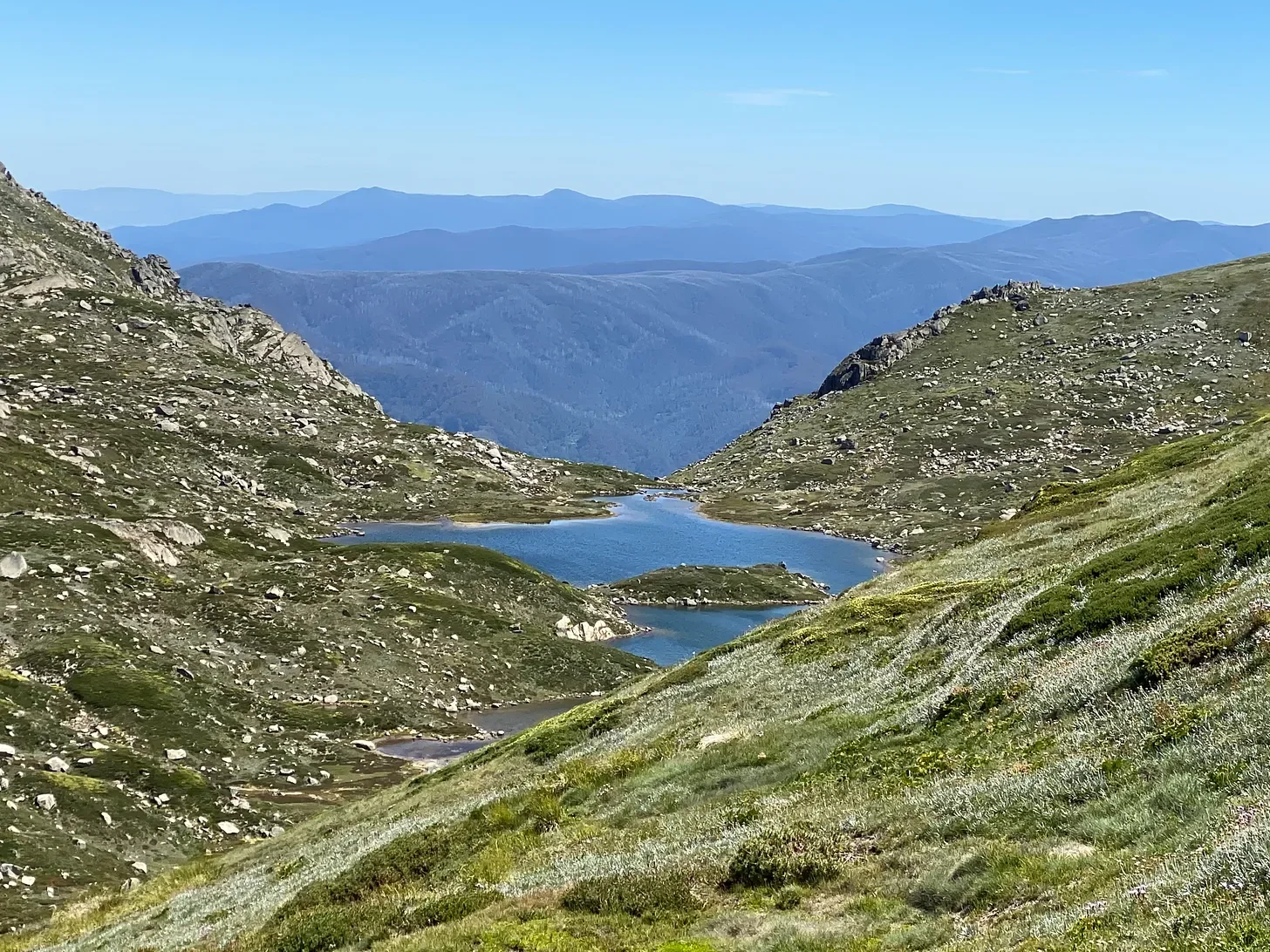
The track brings you to Blue Lake.
Blue Lake is glacial, carved by glaciers from the granite of the Great Dividing Range. Its colour shifts with the angle of the sun. After hours of moving water, the water is still. It is dense and quiet. Sitting above it, looking out across the lake, across the long ridge to Carruthers Peak and Mount Twynam. It is spectacular.
Kigo here is not the last of winter snow, daisies, or flies. It is the idea that, in this place, summer is the brief window each year when the lake is easily reached. The rest of the year, it lies under snow or behind weather that turns the walk into a trek. To be at Blue Lake in summer, to be here in the one season when this landscape is open to the walker. Summer itself is the season word.
The Cotswold Way in summer
The English summer handles water differently. On the Cotswold Way between Painswick and Dursley, water rarely announces itself. You walk a ridgeline of beech and ash, across sheep pasture and through ancient field systems, and the water is simply there beside you, unremarked: a spring pouring from the base of a limestone wall, a small run-off waterfall in a wooded hollow, or a trickle across the path.
The surprise is the kigo here. You come over the brow of Haresfield Beacon and the Severn Vale opens below, the river a broad silver curve against the green, patterned by hedgerows and pasture. Forty miles of England, and in the middle of it a river doing what the stream on the Main Range did, only at the scale of a country.
Lower down, the Cotswold Way runs beside the Stroudwater Canal. The canal water moves so slowly that you can see its surface but not its current. There are narrowboats painted in bright reds and greens, dog-walkers on the towpath, and families on bikes. The canal is water as shared infrastructure. It flows, performing its old work of joining places and people, but held to a human pace.
A seventeenth-century manor house, now a hotel, has a garden that opens directly onto the canal. Adjacent to the garden, so close that older maps show a path from the Court door to the church door, stands St Cyr’s Church.
On a Sunday morning, I started my journey along the Way, strolling by the canal as the church bells rang out. Their sound echoed over the tranquil water, enhancing the walk, a memory I remember most days.
The water under the towpath flowed steadily, without seeming to flow, while the bells marked the human time. These two types of time coexist. It was a continuous flow, as it had always done alongside the ritual and rhythm of daily life and the weekly cycle
Bashō also noticed this, though differently:
Summer river —
the pleasure of crossing,
sandals in hand.
The pleasure is not in the destination. It is in the momentary coincidence, stride and stream, the walker’s time with the waters. Walking past St Cyr’s Church on a Sunday morning, there was the pleasure of crossing a morning held, marked by bells and a slow canal.
Flow
Flow is a psychological concept describing the state where action and awareness unify. Usually, it occurs when facing a challenge — like a climber on a rock or a musician on stage — but it can also happen in the opposite way. When attention becomes so focused that the walker no longer intentionally observes the landscape, the landscape seems to move through the walker naturally.
This is where kigo and flow meet. Seasonal attention is a form of flow that requires no effort. It requires only that the walker pay attention: this grass, this cicada, this stream, this bell. This specific attention lets the continuous in. We become part of what we are walking through.
Both my summers — the Australian alpine one, the English valley one — taught the same lesson. On the Main Range, flow arrived as silence, broken by water. On the Cotswold Way, it arrived as a pattern across layered time. Different countries, different hemispheres, different months, but the same season.
Bashō Returns
Oku no Hosomichi begins with the opening paragraph:
Days and months are travellers eternity. So are the years that pass by. Those who steer a boat across the sea, or drive a horse over the earth till they succumb to the weight of years, spend every minute of their lives travelling. There are a great number of ancients, too, who died on the too, who road. I myself have been tempted for a long time by the cloud-moving wind - filled with a strong desire to wander.
All that follows—every crossing, each haiku, and every small human encounter—falls within that frame. Time is walking, time is on foot.
Water in the landscape shows us this clearly. It is constantly flowing, arriving, and transforming—both the same water and different water at each moment. Walking alongside it isn't just about admiring beauty; it's about observing what life has always been doing—moving, resting, leaving marks, renewing itself—and joining its rhythm, even if only briefly.
Summer is a brief kigo. The Main Range is open for a few months; the Cotswold paths are at their greenest in July; the bells ring at St Cyr’s, and then the morning moves on. The walker’s task is not to hold on. It is worth noticing and letting that noticing change us. The water will do the rest.
