The art of looking up
How cloud gazers remind us that insight begins with attention, not acceleration.
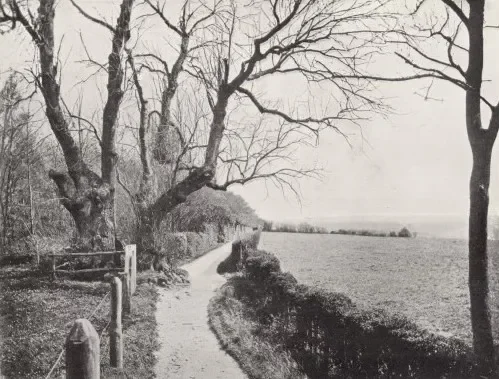
(Image: Charles Darwin’s “thinking path”, Devon)
Also published on my Substack, Wombat Safari
“Look up.”
Motto of the Cloud Appreciation Society
In a world fixated on growth, performance, and motion, the Cloud Appreciation Society's motto is valuable: Look up.
It’s a quiet rebellion against keeping our heads down in the phones and calendars that tether us to the endless present. Unlike the usual imperatives to go faster, do more, and make it bigger, ‘look up’ isn’t an invitation to change the world; it’s a reminder to notice it.
In a culture that prioritises distractions and measurable outcomes, looking up may appear naïve or self-indulgent. However, this shift in focus holds the potential to unlock a sense of wonder.
The genius of obsession and contemplation
In his essay The Bus Ticket Theory of Genius, Paul Graham proposes that what sets geniuses apart is not intelligence in the conventional sense, but rather an unusual kind of obsessive attention. He uses the ‘bus ticket collector’ to explain his theory:
“There are people who collect old bus tickets. Like many collectors, they have an obsessive interest in the minutiae of what they collection. They can keep track of distinctions between different types of bus tickets that would be hard for the rest of us to remember. Because we don’t care enough. What’s the point of spending so much time thinking about old bus tickets?”
Charles Darwin offers a perfect example.
Darwin spent eight years studying barnacles before publishing On the Origin of Species. While understanding barnacles was crucial for ships at the time, it was also a niche pursuit.
Studying barnacles helped Darwin hone the tools and questions that led him to his theory of evolution. Before he revolutionised life on Earth, Charles Darwin was a barnacle-collecting obsessive.
However, something else lay between Darwin’s obsession and his breakthrough: aimless wonder. Wonder moved him from a fascination with life in its tiniest, strangest forms to an openness that allowed him to see life on a grand scale.
Walking as a thinking practice
Darwin’s obsession extended beyond his studies; it was ingrained in his daily routines. He maintained a highly structured and disciplined schedule that balanced intense intellectual work with rest and recovery.
He rose early, had a quiet breakfast alone, and dedicated his most productive morning hours to writing and research. Mid-morning, he would take a walk, using the time to think deeply. After a light lunch, he returned to lighter tasks like writing letters or editing, followed by a short afternoon nap (another underrated practice). He took a second walk in the late afternoon to clear his mind and spent his evenings reading, relaxing with his family, or playing backgammon with his wife.
Darwin’s routine alternated between focus, physical movement, and rest. In contrast, modern working life involves distractions, transportation (by bus, train, or car), and often leads to evening exhaustion.
Darwin referred to the gravel path near his home in Kent as his “thinking path.” He wasn’t alone in this walking habit. Søren Kierkegaard, the Danish philosopher, wrote, “I have walked myself into my best thoughts.” Rousseau, Nietzsche, Thoreau, and countless others regarded walking as an integral part of their intellectual lives.
Charles Darwin’s “thinking path”, Devon
Recent neuroscience has ‘discovered’ what we’ve long known: walking is a catalyst for creativity. It not only enhances associative thinking and reinforces memory consolidation but also relaxes the brain’s executive control, paving the way for more imaginative and nonlinear thought processes.
Walking is more than just a cognitive boost; it changes our tempo, slows us down, and tunes us in. It encourages attentiveness. And in its slowness, we begin to notice and look up.
The value of ‘idlers’
Measured by the standards of today’s working routines, Darwin, with his walks and naps, would be seen as an idler. Yet, he was undeniably productive. His routine was characterised by deliberate changes in perspective and attention incorporated into his disciplined daily schedule.
In his essay, An Apology for Idlers, Robert Louis Stevenson argues that a life preoccupied solely with usefulness is narrow.
“There is no duty we so much underrate as the duty of being happy.”
Looking up is both a physical action and a mental shift. It interrupts the confines of tunnel vision and alters the flow of task management. This action enables us to become aware of what lies beyond our immediate surroundings. By looking up, we create room for unexpected insights, broaden our perspective, and gain the capacity to observe the world without the pressure to control or obtain anything from it. There is no judgment here regarding productivity or lack thereof.
This is what the Cloud Appreciation Society celebrates: not clouds as objects or data, but as they are impermanent and fascinating.
Like idleness, looking up can be considered trivial or indulgent, a luxury for those with too much time and not enough commitment. However, as Stevenson suggests and Darwin shows, activities that seem unproductive are often the most essential for nurturing imagination and clarity.
Looking up is not passive. It’s an intentional act of attention — a quiet defiance against the pressure to be constantly useful. It invites presence without urgency and attentiveness without any agenda.
At a time when burnout is becoming a defining feature of working life and wellbeing is steadily declining, learning to look up may not be a luxury but instead a vital life skill.
After all, wonder isn't a waste of time. It’s how we start to see differently.
Walking, looking up, and wondering
What connects bus ticket collectors, barnacle researchers, walkers, and cloud-gazers?
It is not brilliance or ambition, but rather attention.
It is a sustained, idiosyncratic attentiveness to things others might overlook. It requires the courage to pursue curiosity beyond practicality and to maintain an interest in noticing when no one else is watching or doesn’t care.
This is often what genius looks like before it’s recognised. It can be eccentric, inefficient, and seemingly irrelevant, until it changes everything.
In a world that rewards speed and measurable outcomes, we need to reclaim the quiet, slow habits that fuel imagination, enhance understanding, and make us more human.
We can walk. We can look up. We can wonder.
