The Wisdom of Wombats: Thoughts While Walking
Why write about walking and (occasionally) wombats?
Also published on my Substack, Wombat Safari
The First Question is Always ‘Why?’
A small word, but one that arrives heavy with self-doubt.
Why am I doing this? Why start something like this? Why keep walking when I could sit? Why write when I could read?
‘Why?’ is a simple question. But, as I begin, it carries weight.
I like walking. I like its rhythm, pace, the time it grants, and how it frees my mind to focus on everything else.
Running? I sometimes enjoy that too, but not in the same way. Running turns my gaze inward. I notice my knees, breath, and hip flexors conspiring against me. I run with purpose. With destination.
But when I walk, I don’t concentrate on the act of walking. I notice the world.
My attention wanders—curiously, generously. I stop thinking about myself. I have become more open.
Walking is Simple. And Incredibly Complex.
The biomechanics of walking upright are miraculous. It’s a marvel we don’t fall over more often—or walk straight into walls while daydreaming.
Our bodies constantly calculate and adjust, integrating vision, balance, momentum, memory, and more. All without conscious thought.
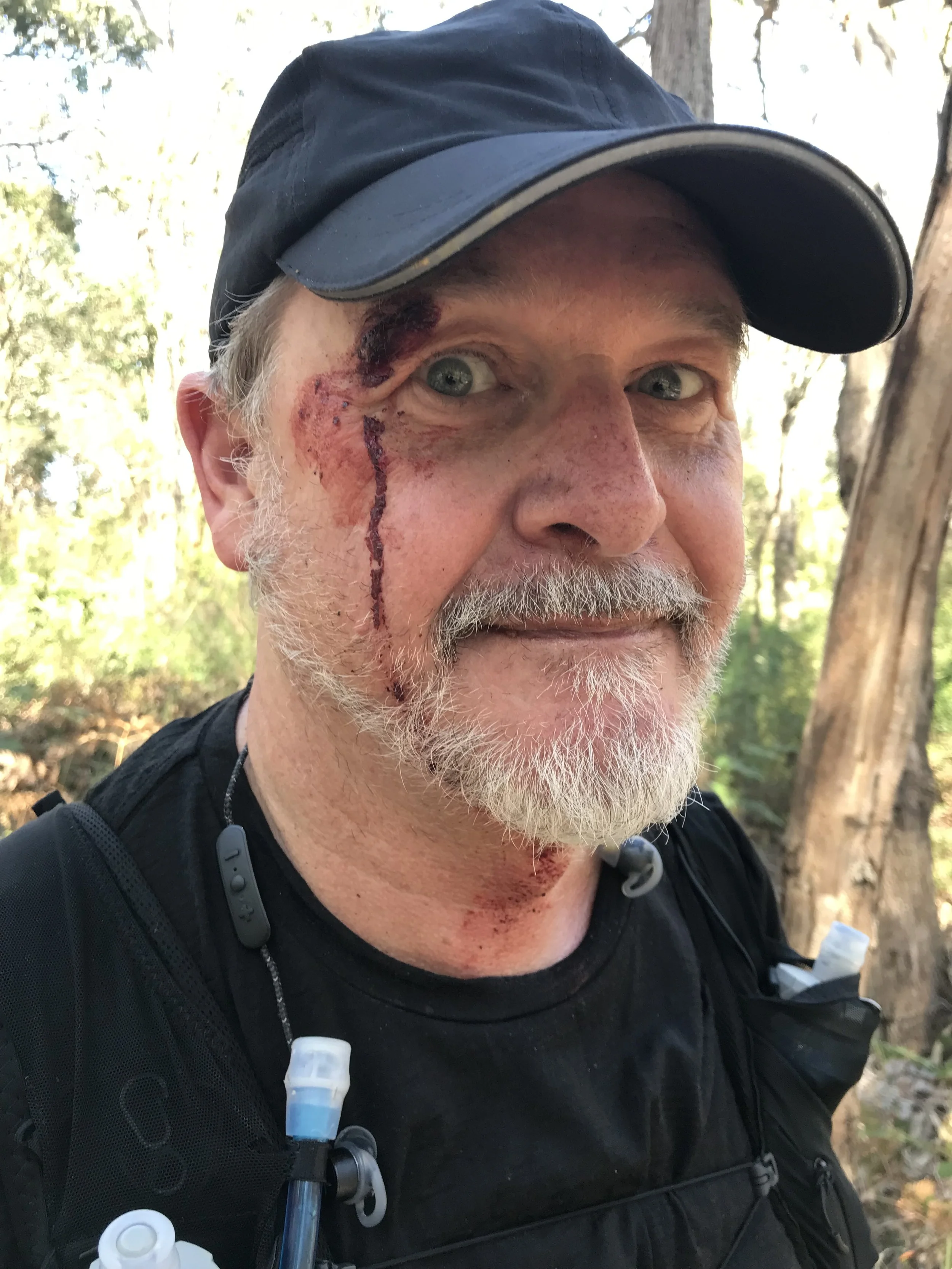
This miracle became absurdly apparent to me about 20 km into a 50-km walk in Victoria. I stopped to take a photo. I felt strong. Confident. Five steps later, I started walking again, tripped over my feet, and collapsed like a sack of potatoes. Or carrots. Let’s go with carrots—it feels more accurate, pointy and awkward.
My head met a rock.
I lay there for a bit, stunned and bleeding from a cut above my eye, like a turtle flipped onto its back.
The fall had no great lesson. No poetic justice. It was just… a fall.
But it reminded me of how much we take for granted in walking. I’d moved flawlessly for 20 kilometres—and in a moment, I forgot how to do it—betrayed by my feet.
Do Feet Have Brains?
It’s not the first time I’ve questioned the mechanics of walking while walking.
For years, especially when trail running (slowly), I’ve wondered whether my feet were operating with independent intelligence. Going downhill, it was clear: I wasn’t consciously choosing where to place each foot. They were choosing for me.
Were they like octopus tentacles—operating semi-autonomously from my brain?
I don’t have the answer. But I’m not alone in my curiosity about walking.
Many thinkers—philosophers, writers, biologists, psychologists—have pondered the mystery and meaning of walking. I plan to read them, reflect on them, and add my observations along the way.
Why ‘Wombat Safari’?
Because I like wombats.
And because, delightfully, the collective noun for wombats is a Wisdom. A Wisdom of Wombats.
I’ve seen them together, heads down, each one absorbed in eating. There is a striking sense of individualism—even in a group—a kind of anti-herd mentality. They keep quiet company. There is mutual respect through mutual indifference.
Wombats keep their wisdom well-hidden.
But occasionally, they leave messages.
Wombats poo in cubes. (This is true. If you didn’t know that, you’re welcome.)
And they don’t just leave them anywhere—they stack them. Often on rocks. The higher the stack, the more interesting it becomes to other wombats.
These mostly nocturnal creatures leave subtle signs of their presence—cubic messages to the world of the day.
So, I walk.
I observe.
I fall occasionally.
And I think about walking and wombats.
Because sometimes the question “Why?” isn’t about answers.
It’s just the beginning of a good walk.
