Walking is an autobiography in motion
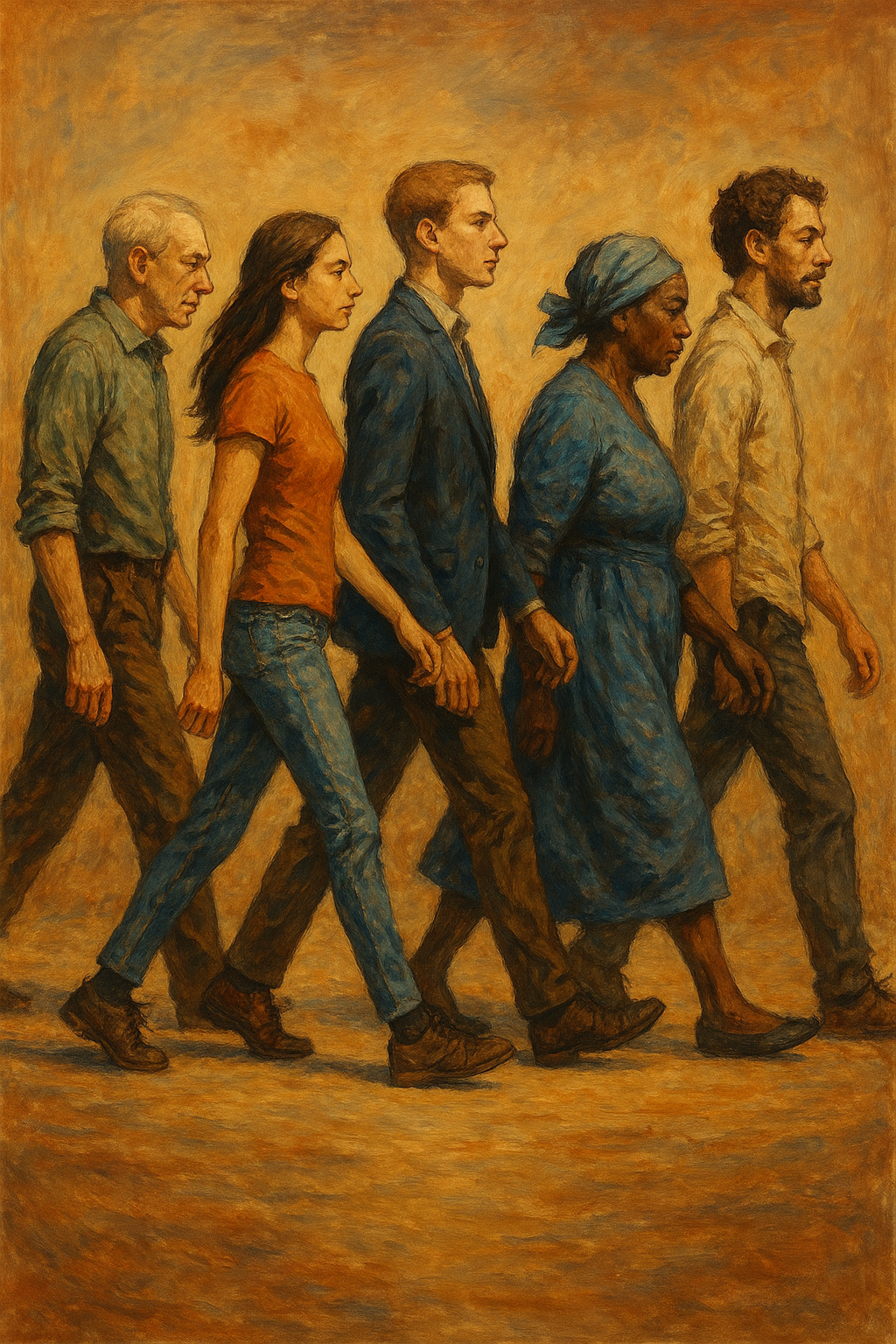
From swagger to shuffle, our gait is a signature of body, mind, and becoming.
Also published on my Substack, Wombat Safari
We learn as much about people through their movements as through their words. How someone walks shows who they are. Walking tells a story of body and mind, history and purpose, with each step.
In ‘Respect for Acting’, Uta Hagen argues that walking always has a destination. The stage direction ‘He wanders aimlessly’ must be interpreted by the actor within the context of the scene and the character. For Hagen, on stage, where time is limited, every action is used to reveal something new about the character or the circumstances.
Physical actions are the necessary balance for verbal actions. When the actor is truly alive on stage there is an endless variety of interaction between verbal and physical behavior. Ideally, the audience should be unable to differentiate whether he walks when he is talking or talks when he is walking!
John Wayne’s slow, rolling swagger told the story of his character, and Charlie Chaplin’s precisely choreographed actions conveyed the story without sound. Distinctive gaits highlight the link between verbal and physical behaviour; they are as unique as a signature.
Signature of self
Engaging in ‘people watching’ offers a glimpse of their character in motion. The swagger of young men, a mix of bravado and insecurity, the hustle of a salesman darting between prospects, the long, purposeful stride of a professional in a rush, the short, swift steps of a delivery driver moving between car and doorstep, and the leisurely circuit of a patrolling police officer all give us insight into their mental state.
Terry Pratchett captured the essence of movement in his character Sam Vimes, Commander of the City Watch. Vimes patrols the city streets as a disciplined extension of his role. “I always have to teach people how to walk”, says Vimes. “You swing your foot, like this. Get it right and you can keep going all day. You’re not in a hurry. You don’t want to miss things.”
Vimes’s gait is slow, economical, and steady. It reflects a man aware of his surroundings but exudes an air of indifference. His walk isn’t flamboyant, but it is efficient. It is a kind of movement that asserts presence without the need for spectacle. Watch police officers patrolling our city streets and you’ll see the same attentive inattention evident in their gait.
Actors, novelists, and keen people-watchers all understand that gait is a language. We interpret it unconsciously on city pavements, through office corridors, and in building foyers. A person’s walk serves as their calling card.
Autobiography in motion
If walking were solely a matter of biomechanics — the structural interaction of ankles, knees, and hips — we might expect it to be the same for everyone. But no two people walk exactly the same. Many factors, including genetics, injuries, occupation, habits, mood, and emotions, influence how we walk. It shows who we are and how we ended up here.
A soldier carries themselves with a stance and stride that are instantly recognisable. Mechanics might display the stiffness of lower back pain in their gait. Office workers’ curved shoulders become an integral part of how they walk. An athlete recovering from a prolonged injury learns to move in ways that minimise the risk of aggravation and re-injury. Age alters our walking rhythm, shortening stride and softening posture. Our fleeting moods influence our gait: sadness slows us down, confidence lengthens our steps, and anger quickens our pace.
Psychologists have demonstrated that observers can recognise these states with remarkable accuracy. Strangers shown blurred point-light displays—just moving dots marking joints—can tell whether the walker is happy, anxious, or depressed. Our gait, it seems, is a constant broadcast, an autobiography in motion.
Walking is a marvel
Walking appears straightforward. We celebrate when children progress from babies to toddlers. Those initial steps are among the most complex feats the body performs. After that moment of ambulatory triumph, we often take the movement for granted.
In clinical terms, walking involves two phases: stance and swing. One foot supports the body while the other swings forward, creating a seemingly effortless rhythm. Yet beneath this is a marvel of coordination.
Muscles, joints, bones, and balance systems all work together to maintain proper function. We can replace parts like knees, hips, and ankles, but without the coordination of the central and peripheral nervous systems, walking falls apart. The brain must send and receive a constant stream of signals to maintain balance, adjust posture, and prepare for different terrain.
Walking, therefore, is more than just a mechanical act. It is a psychological process. Consider the effort of a stroke survivor relearning to walk: every step requires concentration. Essentially, they are rebuilding their sense of self with each stride, just as they are regaining the ability to walk.
The neurochemical regulation of walking cannot be separated from the lived experience of being a person in motion. We return to Uta Hagen’s observation about the constant interaction between verbal and physical behaviour, to which we now add our psychological and philosophical outlook.
The marvel of walking reminds us that what looks ordinary is extraordinary.
Transformation, revelation, and the philosophy of gait
Philosophy has long associated walking with mental and spiritual transformation and revelation. Nietzsche argued that only thoughts born of walking held value. Pilgrimage, across all traditions, transforms steps into an act of faith. To walk is to embody change, both inside and out.
Yet gait is not only mentally transformative but also revealing. Our inner states are shown through our posture and pace, whether we wish them to be or not.
Often overlooked is that within social groups, we are also beings of deception. We hesitate to reveal our true selves to others; we aim to present ourselves as something we aspire to be, or something we are not.
In the final scene of The Usual Suspects, Kevin Spacey’s character, ‘Verbal’ Kint, much like in the rest of the film, appears as a disabled, frail con artist. However, when he exits the police station, his limp vanishes; his walk becomes confident and straight. This silent shift in his movement reveals his true nature—he is the mastermind behind a multi-million-dollar theft—without a single word being spoken.
We can alter our inner states by altering our gait. Experiments in embodied cognition demonstrate that walking with longer strides and an upright posture can enhance mood and confidence. The old saying—if you walk with purpose, purpose will follow—is not just a metaphor. Our gait is both a reflection and a tool, a way of shaping the self we become.
Walking into who we are becoming
To watch someone walk is to glimpse their unfinished autobiography.
Gait is not just neutral mechanics; it’s a reflection of identity. It reveals genetics, injuries, habits, labours, moods, and emotions. It’s a marvel of neurology and psychology, simultaneously mechanical and mental.
And it is a philosophy of becoming: revealing who we are, while also shaping who we may yet be.
