Night Walking: Walking, darkness, attention, and community
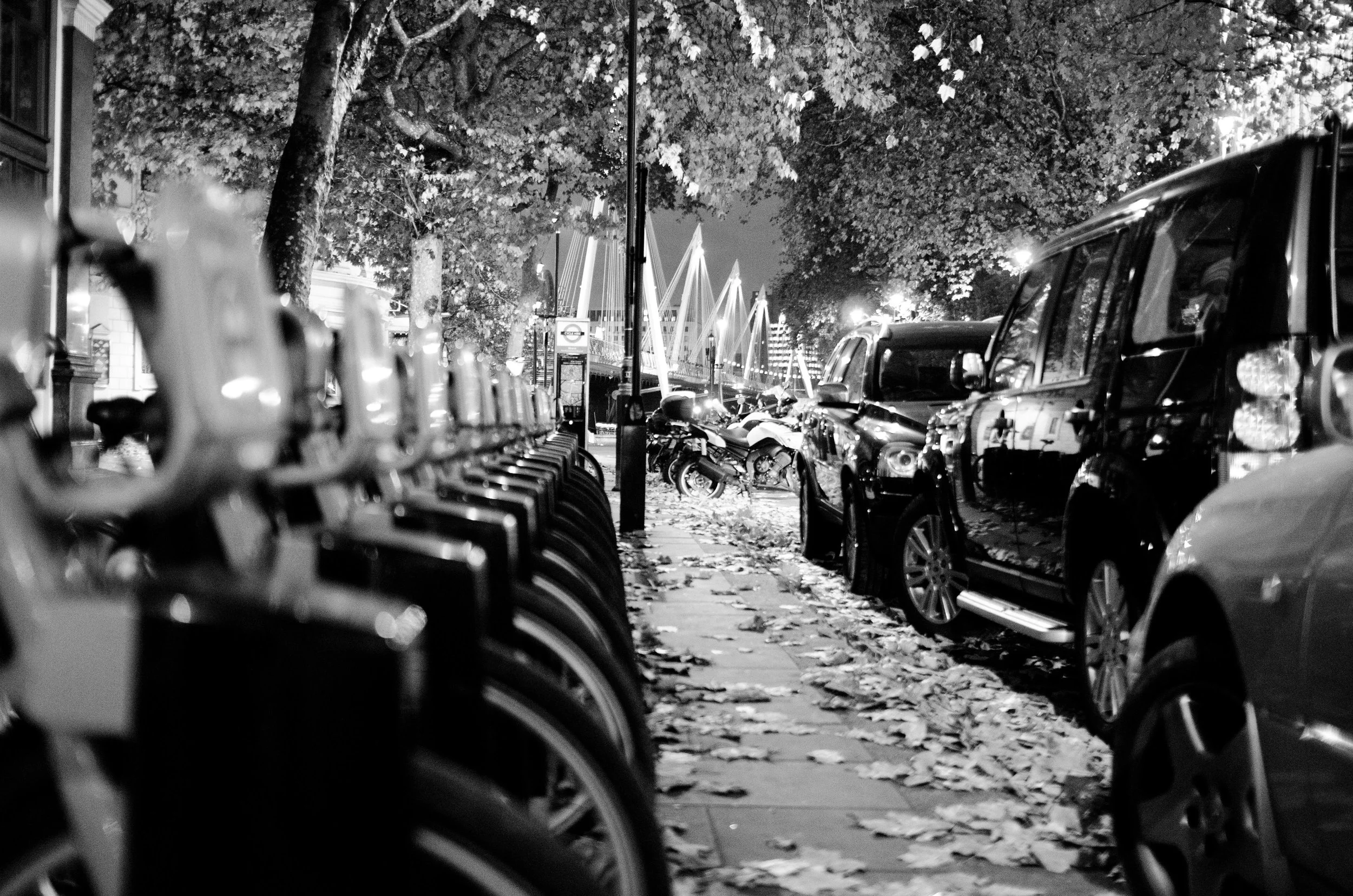
In an era when our hope for the future is under pressure, our trust in others has eroded, and community bonds have frayed, perhaps we should adopt the Italian perspective on night-time strolls rather than Dickens’.
First published on Substack.
Years before he wrote about it, Charles Dickens experienced a bout of temporary insomnia that drove him into London's night. It was March, with damp, cold weather. The source of his sleeplessness, which he never explicitly explained, was only hinted at; biographer Matthew Beaumont suggests it was grief—his father had died the previous year, and his marriage to Catherine was quietly dissolving. Dickens's self-treatment was to get up, go out, and walk until exhausted.
His essay, titled “Night Walks”, is both strange and characteristically precise. On these nights, Dickens says he “finished [his] education” through an amateur experience of houselessness, developing sympathy for people who live that way every night.
Early on, the night offers the “entertainment” of the city’s restlessness as it “tumbles and tosses” before settling to sleep. But later, when the lights go out and the streets are quiet, the “houseless mind” yearns for any sign of company: a lighted window, movement, or any indication that someone is awake.
During the quietest hours, Dickens describes passing a policeman or catching a glimpse of a secretive figure in a doorway. In both cases, they silently observe each other and then part ways, feeling "mutually suspicious". He notes that sounds, such as a church clock, can momentarily seem like “company”, but this impression is soon corrected, leaving a deeper sense of loneliness.
Dickens depicted a London that was not just about daytime commerce and social interactions. Instead, it was more mysterious, more intense, and, in some respects, more complex. Darkness does something specific to the lone night walker.
Vision, the dominant sense of waking life, is reduced; in its place, hearing sharpens, smell intensifies, and the body’s sense of itself in space comes to the fore in a way it rarely does during the day. The walker moving through a familiar street at night processes it through underused senses.
The sound of footsteps returns differently off buildings; the smells are different and can arrive with unexpected force. The city, read by daylight through its shops, signage, and the faces of strangers, must now be read through touch, sound, and imagination. It is a different kind of perception: slower, more bodily, and more alert.
The city, neighbourhood, or street encountered at three in the morning is not the daytime city, grown quiet and dark. It is, as Dickens implies, a different entity, with different demands, different people, and a different relationship to the person moving through it.
During the day, the street functions as a social stage where we dress and perform, signalling who we are in ways strangers can quickly interpret. At night, Dickens sought companionship among strangers by arriving early at a railway station to watch the mail train arrive. For a moment, the station feels lively—lights flare, porters arrive, cabs and carts position themselves, and the bell rings loudly as the train pulls in. However, after about ten minutes, the lights dim, the station empties, and Dickens finds himself back where he started: “…the lamps were out, and I was houseless and alone again.”
For Dickens, night walking fed his fiction. In this, he belongs to a tradition of literary and philosophical walkers stretching back to Robert Louis Stevenson, who wrote about night walking in Edinburgh, sharing a similar sense that, after hours, the city sheds its respectable skin.
Robert Macfarlane, in his acclaimed book The Old Ways, opens with a night walk he took two days before the winter solstice, carrying tradition into our contemporary experience. His nocturnal expedition shows how darkness demands renewed attention and restores a quality of alertness that habitual daylight walking had smoothed away: “The moonlight was so bright that everything cast a crisp moon-shadow: black on white, stark as a woodcut.”
Walking at night does not subtract from our experience; it adds new experience through a different combination of senses.
Dickens walked his houseless miles without seeming to consider the dangers. The tradition of nighttime wandering—where the literary figure explores what darkness reveals—is largely a male pursuit. Women in the same cities and eras, as today, saw the night streets as risky rather than revealing.
On 12 November 1977 in Leeds, the Leeds Revolutionary Feminist Group organised what became Britain's first Reclaim the Night march. This occurred amid the Yorkshire Ripper murders, during which Peter Sutcliffe had killed seven women across Yorkshire by then. The police advised women to stay indoors after dark.
While the advice seemed practical, feminist organisers saw it for what it was: a curfew. Women marched through Leeds that night with signs reading: “No Curfew on Women — Curfew on Men.” As organiser Al Garthwaite explained, the march was fuelled by anger at the fact that, in effect, there was a curfew on women but not on men.
In the years since Dickens walked, we have pushed back the night. In the decades since 1977, artificial lighting has spread across cities, achieving near-total coverage, and video surveillance has multiplied. Yet the night street is, for most people, a space they move through quickly and with purpose rather than slowly and with attention.
The city after dark, once the province of the sleepless, the curious, and the dispossessed, has contracted into a journey between two well-lit, closely monitored spaces. We have traded the night walker’s unencumbered solitude for the lit corridor between destinations, moving through the dark rather than into it.
Looking at night walking from the perspective of solitary figures guides us down one path. But there are other traditions, such as the Italian passeggiata, that offer different possibilities for night walking.
In Italian villages and neighbourhoods, a tradition exists of people going out every evening to stroll, to see and be seen, and to feel a sense of community in public spaces. The nighttime walk is neither lonely nor intimidating, but rather communal.
Between Dickens’s houseless miles and the passeggiata lies our contemporary night city: brightly lit, heavily monitored, and largely emptied of people with no clear destination. We have not replaced one form of night knowledge with another. Instead, we have thinned the night into a corridor between two spaces, passing through it quickly rather than learning to dwell within it.
Maybe that's why traditions like the passeggiata are appealing. During these evening strolls, the night doesn't belong solely to loners or passing cars but to the community as a whole. This raises a question about our expectations for the night: should it be a space for social interaction and gathering, or a place to pass through as quickly as possible?
In an era when our hope for the future is under pressure, our trust in others has eroded, and community bonds have frayed, perhaps we should adopt the Italian perspective on night-time strolls rather than Dickens’.
