Footpath
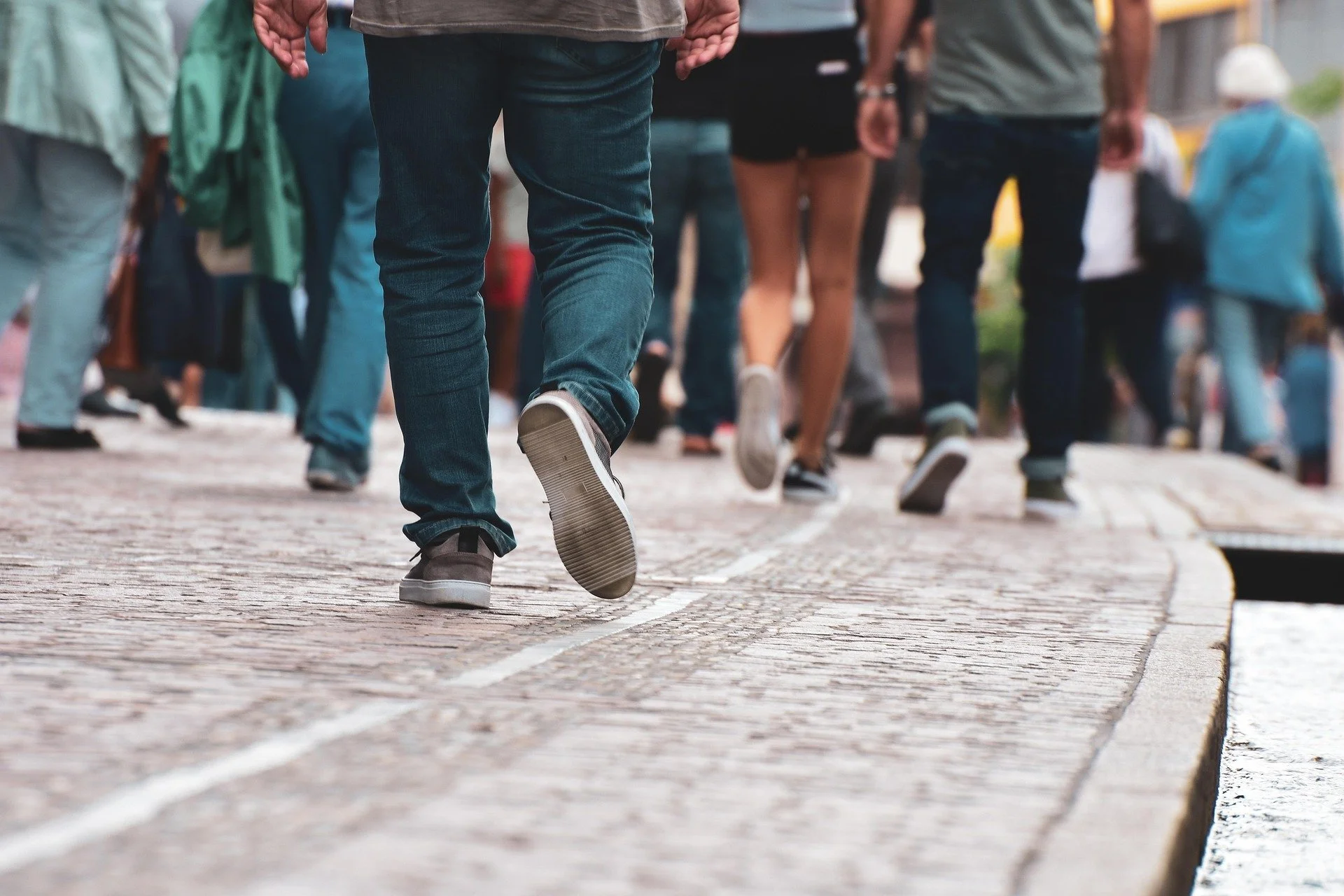
Purposeful movement
Pattern and space maintained
Alone in a crowd
Every day, one of the most intricate choreographies of modern life unfolds along the footpaths of our towns and cities.
People move with purpose, carrying a destination within them: meeting a friend, getting lunch, or heading home.
We move in a bubble of purpose. The body leans slightly forward, eyes scanning not only ahead but also across, calculating the dynamics of speed and angle. There is little speech between pedestrians, yet they are in constant, if fleeting, communication. A half-step to the left, a brief slowing, a narrowing of the shoulders, or shared navigation of street furniture. The dance of give and take unfolds in micro-gestures of eyes, head, and body.
~
There are cultural rules. We keep to one side, often without remembering when we learned to do so. In Australia, as in the United Kingdom, we tend to pass on the left, in the United States, on the right. These are not laws etched into the pavement, but habits woven into cultural muscle memory.
The quirk of history and design that results in English people walking on the left side of the footpath but staying to the right on London Underground escalators reinforces how entrenched patterns remain, even when they are counterintuitive to normal practice.
The footpath becomes a living diagram of shared expectations. Without these small agreements, movement would collapse into friction.
~
There is an unspoken rule of personal space that varies with crowd density. In busy city streets, this boundary narrows but remains. We are near each other but don’t get tangled. The remarkable thing isn't the occurrence of conflict, but how frequently it is avoided.
Sociologist Erving Goffman described this behaviour as “civil inattention”: a subtle way of acknowledging others without being intrusive. We notice others, but we do not stare. We recognize their presence, but we do not insist on attention. It is a practice of restraint and a form of public courtesy that enables strangers to coexist in shared spaces without revealing too much or demanding too much of each other.
~
The footpath offers a specific kind of solitude. When we are strangers in a crowd, we stay locked in on ourselves. Our thoughts persist in their private flow: rehearsing dialogues, unresolved disputes, and upcoming plans. We stay subtly attentive to the crowd around us, but mostly it functions as a shifting background to our introspection. Although we are part of a bigger pattern, each of us walks a specific path.
The footpath teaches that cohesion does not require uniformity of belief; it requires patterned habitual behaviour. We do not need to agree on meaning to agree on movement.
~
The footpath’s self-synchronising coordination is moderated by agreed patterns, manners and restraint. It is a conductorless orchestra. No announcement signals when to step aside. The pattern emerges from countless small micro-decisions made in fractions of a second.
It is a lesson in leadership as much as in group behaviour. Large organisational systems depend less on grand declarations of vision and mission than on sustained patterns of mutual adjustment. When those patterns fray, friction intensifies, and self-synchronisation degrades into collision.
But when it works, it works almost invisibly. Progress is not dramatic.
The footpath, then, is not merely infrastructure. It is a rehearsal. A daily practice in balancing self-direction with collective order. A reminder that we can move toward our own purposes while preserving the space of others.
