The Ancient Mariner and the forgetting of change, or why transformation takes time, and why we rarely remember how it happened
Organisations also change slowly. Structures can be redrawn in a week, but the habits, loyalties and tacit cultural understandings that sustain a system take years to realign. Yet leadership attention is often consumed by the short term.
Ralph Waldo Emerson once observed that “Nothing is got for nothing.” Every act of creation carries a cost. Change, whether personal or institutional, operates within what might be called a moral economy of exchange. Attention, trust and meaning are its scarce currencies. Yet organisational leaders often behave as if transformation were a transaction without price and progress a commodity that can be purchased instantly.
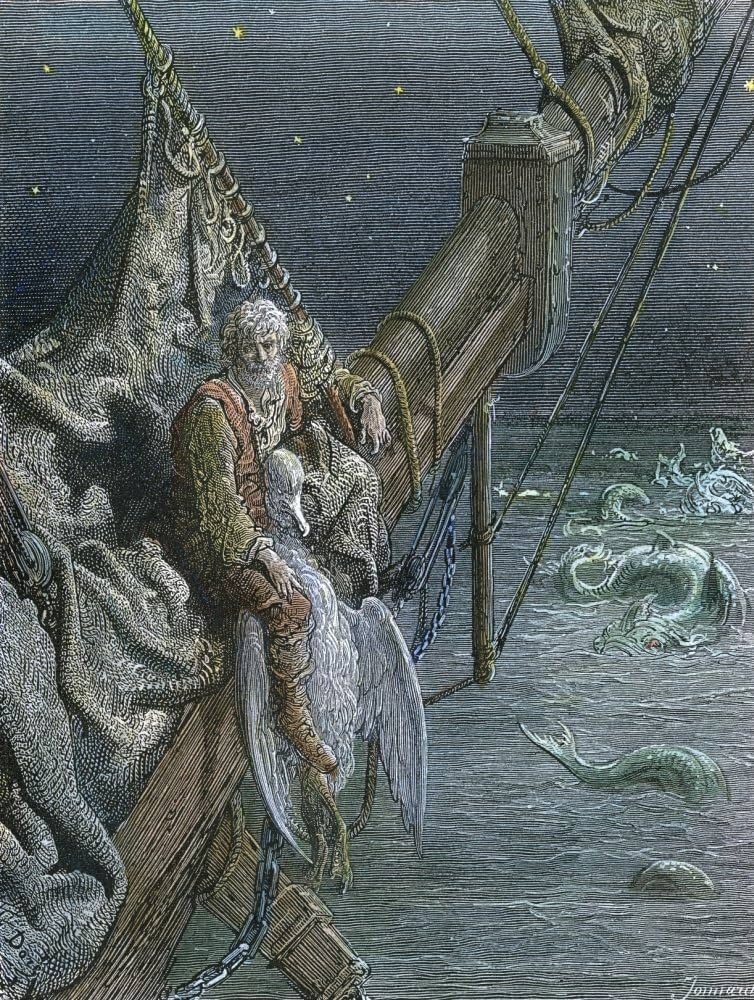
Samuel Taylor Coleridge’s Rime of the Ancient Mariner is a parable of that illusion. The Mariner kills the albatross on impulse, an act so trivial and irrational it seems almost absurd. Yet from this single gesture, a vast sequence of consequences unfolds. Becalmed on the open sea, he discovers that nothing moves, nothing renews, until he accepts responsibility for what he has done. When change finally comes, it is neither sudden nor simple but slow, moral and costly.
The poem captures two truths about transformation that leaders easily forget: it takes time, and if it succeeds, it is quickly forgotten.
I. The pace of real change
In the poem, the Mariner’s suffering is prolonged. The sea itself becomes a measure of time, holding him in suspense until he learns to see differently. “Alone, alone, all, all alone,” he cries, suspended between guilt and grace. His transformation cannot be rushed because what must change is not his circumstances but himself.
Organisations also change slowly. Structures can be redrawn in a week, but the habits, loyalties and tacit cultural understandings that sustain a system take years to realign. Yet leadership attention is often consumed by the short term. Performance frameworks, budget cycles and political pressures reward immediacy. The deep work of cultural renewal is postponed in favour of visible action.
This impatience distorts judgment. Leaders treat change as a sprint rather than a voyage. They forget that progress is often invisible in its early stages and that genuine transformation may even seem to fail before it succeeds. What looks like resistance can be the necessary turbulence of adaptation.
Coleridge’s poem reminds us that transformation unfolds over time, not within it. The process itself creates the conditions for understanding. Just as the Mariner must endure the sea’s stillness, organisations must often pass through discomfort before renewal becomes possible.
II. The illusion of failure
In the public and business sectors, reform often looks unsuccessful when viewed through a short lens. Reviews are conducted, recommendations adopted, and new structures created. For a while, activity replaces understanding. When results are slow to appear, critics declare the effort a waste. Yet the benefits of reform often surface years later, when its origins have faded from memory.
Many of the most significant public service transformations have followed this pattern. The Coombs Royal Commission in the 1970s faced resistance and fatigue, yet decades later its influence on professionalisation and accountability is taken for granted. More recent reforms in digital service design or collaborative governance may seem messy and incomplete, but they are reshaping expectations of how government should work.
Like the Mariner’s ordeal, these changes are cumulative and moral rather than mechanical. They work through the slow redistribution of attention, trust and authority. They cannot be measured by quarterly metrics or by any one leader’s tenure. Their apparent failures are often the necessary cost of long-term success.
III. The forgetting of transformation
If change succeeds, it tends to disappear. Once new ways of working become normal, the process that produced them is forgotten. The hard conversations, compromises, and uncertainty that once seemed unbearable fade into collective amnesia.
This forgetting is not accidental. It is a feature of institutional life. Organisations prefer to remember outcomes rather than origins. They commemorate success while suppressing the discomfort of its creation. To recall transformationhonestly would be to remember that power once shifted from the centre to the margins, that authority was contested, and that renewal began with doubt.
In the poem's language, the albatross is not merely a symbol of guilt but of connection. When the Mariner kills it, he severs his bond with the living world. His redemption begins only when he sees beauty again in what he once despised. Yet he cannot escape the memory of his act. He is condemned to retell it, reminding others that every act of creation bears the trace of destruction.
Organisations need their own Mariners, those who remember how change happens. They hold the inconvenient knowledge that progress was once uncertain, that innovation began as dissent, and that new wisdom emerged from the periphery rather than the centre. Without such memory, institutions risk mistaking stability for virtue and novelty for progress.
IV. The moral economy of time
Leadership is often described as the management of people and resources, but it is also the stewardship of moral time. The leader’s task is to hold the tension between the urgency of action and the patience required for understanding.
There are at least three forms of time at work in any transformation. The first is chronological time: the schedules, milestones and deadlines that structure official life. The second is psychological time: the slower rhythm through which people process loss, adjust to uncertainty and rebuild trust. The third is moral time: the period required for new practices to become genuine habits and for values to migrate from policy into conduct.
Most change programs recognise the first, struggle with the second, and ignore the third. Yet without moral time, reforms do not take root. They remain technical rearrangements on the surface rather than transformations at the depth.
The Mariner’s long journey home captures this temporality. His redemption is not instantaneous; it unfolds, with guilt, recognition and grace coexisting. He learns to bless the water-snakes “unawares” only after enduring the stillness that forces him to see. In the poem, time is not an obstacle to change but its medium.
V. The danger of short-term leadership
When leaders fixate on the immediate, they overlook the unseen benefits that only time can reveal. They declare a change a success or a failure long before its consequences are visible. This short-termism is reinforced by political cycles and public impatience, yet it erodes institutional memory and rewards activity over understanding.
A leader who treats transformation as a race to completion may deliver efficiency but not renewal. The deeper challenge is to build systems that can learn, remember and adapt beyond any individual’s tenure. This requires humility: the recognition that future generations, not the tempo of measurement and reporting, will judge the meaning of one’s work.
Coleridge’s Mariner cannot escape this logic. He is condemned to tell his story again and again, knowing that its effect will be felt in others, not in himself. The wedding guest who hears the tale departs “a sadder and a wiser man.” The change the Mariner could not achieve within himself is carried forward by those who listen.
This is a fitting image of leadership. Transformation rarely ends with the initiator. Its full value is realised when others inherit it, make sense of it, and incorporate it into organisational rules and traditions.
VI. Remembering how change happens
Organisations thrive when they create spaces to remember not only what was achieved but also how it was achieved. This goes beyond a formal evaluation. It means recovering the lived experience of those who endured the transition: the uncertainty, the resistance, the slow reweaving of trust.
Such remembrance serves a moral purpose. It grounds the institution in gratitude rather than triumphalism. It reminds those in power that authority is temporary and that renewal often begins in the margins they might be tempted to ignore.
One way to institutionalise memory is through reflective storytelling: after-action reviews, oral histories, or case studies that preserve both the moral and operational lessons of change. These stories become a kind of organisational conscience, carrying forward the awareness that nothing is gained without cost.
VII. The quiet after the change
At the close of the poem, the sea is calm, and the ship returns home. The Mariner disappears into the crowd, leaving the listener changed.
Successful transformation follows a similar pattern: the noise diminishes, routines get back to normal, and the new state feels natural. However, below the surface of calm, the memory of the struggle remains. Leaders face the challenge of maintaining that memory long enough to guiding the next phase of renewal.
Every organisation exists within a moral economy of time. Its wealth is not measured by speed but by depth, not by how quickly it moves but by how wisely it remembers.
The task of leadership is to balance the ledger: to invest patience where urgency reigns, to value reflection as much as performance, and to ensure the story of change does not vanish once the sea grows calm again.
Transformation takes time. Its benefits are slow, often unseen, and easily forgotten. Yet in that slow, forgetting process, institutions learn who they are and what they might become. The Ancient Mariner’s lesson is simple: nothing is got for nothing, and the wisdom of change belongs to those with the patience to remember how it happened.
